Writing guide
NU552 Advanced Health Assessment: How to Write SOAP Notes and Differentials
Purdue Global writing guide
How to Write NU552 SOAP Notes
Ranked differentials, outpatient ICD-10 coding and a worked chest pain note.
- BSN, MSN & DNP levels
- Written from scratch
- Free revisions
Key points
- Put each finding in exactly one section: what the patient reports is Subjective, what you measure is Objective.
- Give every differential findings for and against it, taken from this patient's history and exam.
- Keep must-not-miss diagnoses, such as ACS and pulmonary embolism for chest pain, at the top until the data rules them out.
- In an outpatient note, code a probable diagnosis as its symptom, not as the diagnosis.
- Cite a current guideline for every test and treatment in the Plan, in APA 7.
What does NU552 Advanced Health Assessment cover at Purdue Global?
NU552, Advanced Health Assessment and Diagnostic Reasoning, is a Purdue Global MSN course that teaches students to take a complete history, perform an advanced physical exam and reason their way to a diagnosis. Expect to show those skills in SOAP notes, simulated patient exams and diagnostic reasoning write-ups; your syllabus lists the ones your section uses.
NU552 is one of the "three Ps" of nurse practitioner education. The other two are NU551 Advanced Physiology and Pathophysiology Across the Lifespan and NU553 Advanced Pharmacology and Pharmacotherapeutics. The APRN Consensus Model, the 2008 national framework for licensing, accrediting, certifying and educating advanced practice registered nurses (APRN Consensus Work Group and NCSBN, 2008), requires a separate graduate course in each.
Read that as a writing hint. An NU552 note that explains why a finding happens (pathophysiology) and why a drug was chosen (pharmacology) reads like an NP wrote it. A note that only lists findings reads like a checklist.
You'll meet the same skills on the NP certification exams set by the AANP Certification Board (AANPCB) and the American Nurses Credentialing Center (ANCC). They're also written into the American Association of Colleges of Nursing's Essentials (AACN, 2021). In NU552, someone marks that reasoning line by line.
The table maps assignment types common in advanced health assessment courses to what graders check and to the section of this guide that covers each one.
| Assignment type | What graders look for | Section of this guide |
|---|---|---|
| Focused SOAP note | Complete Subjective and Objective, ranked differentials, cited Plan | How to write a SOAP note; worked example |
| Comprehensive history and exam | Full review of systems, head-to-toe exam | Comprehensive vs focused SOAP notes |
| Diagnostic reasoning write-up | Findings for and against each diagnosis | How to build and rank a differential |
| Shadow Health assessments | Data collected, documentation, education and empathy | How Shadow Health is set up |
Your syllabus and rubric set the actual assignments and their weightings, and they always override this table.
The Purdue Global nursing course guide lists the rest of the MSN program, including NU551 and NU553.
How do you write an advanced health assessment SOAP note?
An advanced health assessment SOAP note has four parts. Subjective: the chief complaint, history of present illness, history and review of systems, as the patient reports them. Objective: the vital signs, exam findings and results you measured. Assessment: your working diagnosis and ranked differentials, with the findings behind them. Plan: tests, treatment, education and follow-up, each tied to a guideline.
The basics are in what a SOAP note is, in short. The version an MSN grader expects goes further. It names a medical diagnosis and defends it, which your RN charting never had to do.
What goes in the Subjective section of a SOAP note?
Everything in the Subjective section comes from the patient, or from whoever speaks for them. The history of present illness (HPI) is the patient's account of the current problem. OLDCARTS is a mnemonic for its eight elements: onset, location, duration, character, aggravating and relieving factors, radiation, timing and severity. The review of systems (ROS) is a system-by-system list of symptoms the patient reports or denies.
Write the Subjective section in this order:
- Chief complaint: the patient's own words, in quotation marks, on one line.
- HPI: every OLDCARTS element. Versions of the mnemonic differ slightly, so use the one your course teaches.
- History: past medical history, medications with doses, allergies with the reaction, family history and social history.
- ROS: each related system, with pertinent positives and pertinent negatives.
A pertinent positive is a reported symptom that supports a diagnosis on your list; a pertinent negative is a denied symptom that makes one less likely. Each pertinent negative should rule something out. In a dysuria note, "denies flank pain and fever" earns its place because it moves pyelonephritis down the list. "Denies hair loss" proves nothing.
Don't write "ROS negative except as per HPI." Busy clinics use that line, but in a student note it hides which systems you asked about. Graders can't give credit for questions they can't see.
What goes in the Objective section of a SOAP note?
Write the Objective section so a colleague could re-examine the patient tomorrow from your note alone. That means a full set of vital signs, the physical exam by body system, and any results from the visit. A focused note examines every system linked to the chief complaint, not only the one that hurts.
Be exact. "Lungs normal" tells the grader nothing. "Clear to auscultation bilaterally, no wheezes, crackles or rub" tells them what you listened for.
Nothing the patient said goes here. "Patient states the pain is 6/10" belongs in the Subjective section.
What goes in the Assessment section of a SOAP note?
The Assessment section is the part of the note NU552 is named for: diagnostic reasoning. It names a working diagnosis and the differentials you weighed, each backed by findings from the Subjective and Objective sections. A working diagnosis is the condition you judge most likely after weighing the alternatives.
Draft the Assessment before you polish anything else. If a finding in your Subjective or Objective doesn't feed a diagnosis here, ask why it's in the note. The full method is in "How do you build and rank a differential diagnosis?"
What goes in the Plan section of a SOAP note?
Split the Plan section into four headings: diagnostics, treatment, patient education, and follow-up or referral. The headings make gaps obvious to you before they're obvious to the grader. Give every line a reason and cite the source, such as a U.S. Preventive Services Task Force (USPSTF) recommendation for screening or a specialty society guideline for treatment.
End with return precautions, written as specific symptoms. "Return if worse" isn't a return precaution. "Call 911 if the pain spreads to your jaw or comes with sweating" is one.
The table shows six items students often put in the wrong section of a SOAP note, and where each belongs.
| Item | Belongs in | Wrong section students use |
|---|---|---|
| "Pain is 6/10 and worse when I breathe in" | Subjective (HPI) | Objective |
| Tenderness at the left 4th costochondral junction | Objective | Subjective |
| "Denies shortness of breath" | Subjective (ROS) | Assessment |
| ECG done during the visit | Objective | Plan |
| "Findings point to costochondritis" | Assessment | Objective |
| Why you chose the treatment, with a citation | Plan | Left out |

How do you build and rank a differential diagnosis?
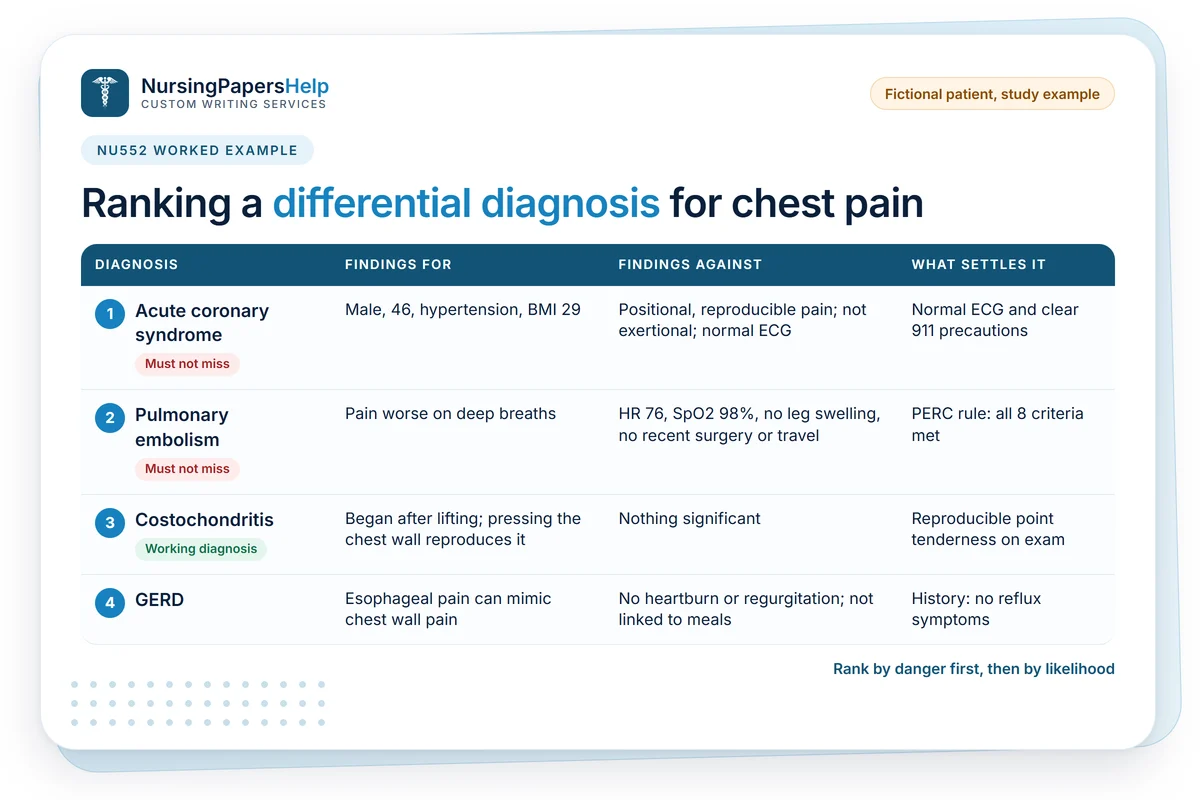
A strong differential diagnosis lists the conditions that could explain the chief complaint, places any dangerous condition you can't yet rule out at the top, and ranks the rest by likelihood. Each diagnosis shows the findings for it, the findings against it, and the test or finding that would confirm or exclude it, so the grader sees your reasoning.
Check the NU552 rubric for the minimum number of differentials. Then resist padding. Three differentials you can argue from this patient's data are worth more than five you can only name.
A must-not-miss diagnosis is a condition that could kill or seriously harm the patient soon if it's overlooked. It goes on the list even when you think it's unlikely, because the grader wants to see you rule it out.
Build and rank the differential in six steps:
- Start from the chief complaint and HPI. Write down every condition that could cause them before you look at the exam.
- Mark the must-not-miss diagnoses. For chest pain, these are acute coronary syndrome, pulmonary embolism, aortic dissection and pneumothorax.
- Sort the findings. For each diagnosis, pull the findings for and against it from the Subjective and Objective sections.
- Rank. Must-not-miss diagnoses stay at the top until the data excludes them. Order the rest by likelihood.
- Name what settles each one: a test, a decision rule or a specific finding.
- Choose the working diagnosis, and say in one sentence why it beats the next one on the list.
What is premature closure in diagnostic reasoning?
Premature closure is stopping at the first diagnosis that fits and not going on to consider reasonable alternatives. In a 2005 study of 100 diagnostic error cases in internal medicine, Graber, Franklin and Gordon found premature closure was the single most common cognitive cause of error. Anchoring, a related bias, is holding on to a first impression after later data points elsewhere.
On paper, premature closure looks like a one-line differential. Or five diagnoses with no evidence under any of them.
Either way, the grader can see you picked the answer first and wrote the reasoning second.
What are immediate and non-immediate diagnoses?
An immediate diagnosis needs action at this visit because missing it could cause serious harm; a non-immediate diagnosis can wait for follow-up or further tests. Shadow Health's Advanced Health Assessment learning objectives (Shadow Health, 2018) ask students to prioritize differentials "to differentiate immediate from non-immediate."
Ask two questions of every diagnosis on your list: how likely is it, and how bad is it to miss? A pulmonary embolism you think is unlikely still outranks the reflux you think is likely, until your note shows why the embolism doesn't fit.
The table shows weak and strong entries for each column of a differential diagnosis grid.
| Column | What to write | Weak entry | Strong entry |
|---|---|---|---|
| Diagnosis | A specific condition | "Cardiac problem" | "Acute coronary syndrome" |
| Findings for | Data from this patient | "Chest pain" | "Male, 46, hypertension" |
| Findings against | Data from this patient | Left blank | "Pain reproduced by palpation; normal ECG" |
| What settles it | A test, rule or finding | "Further workup" | "PERC rule: all 8 criteria met" |
The NursingPapersHelp NU552 diagnostic reasoning sample on low back pain applies the same method to a musculoskeletal case.
What does a strong NU552 SOAP note look like? A worked example
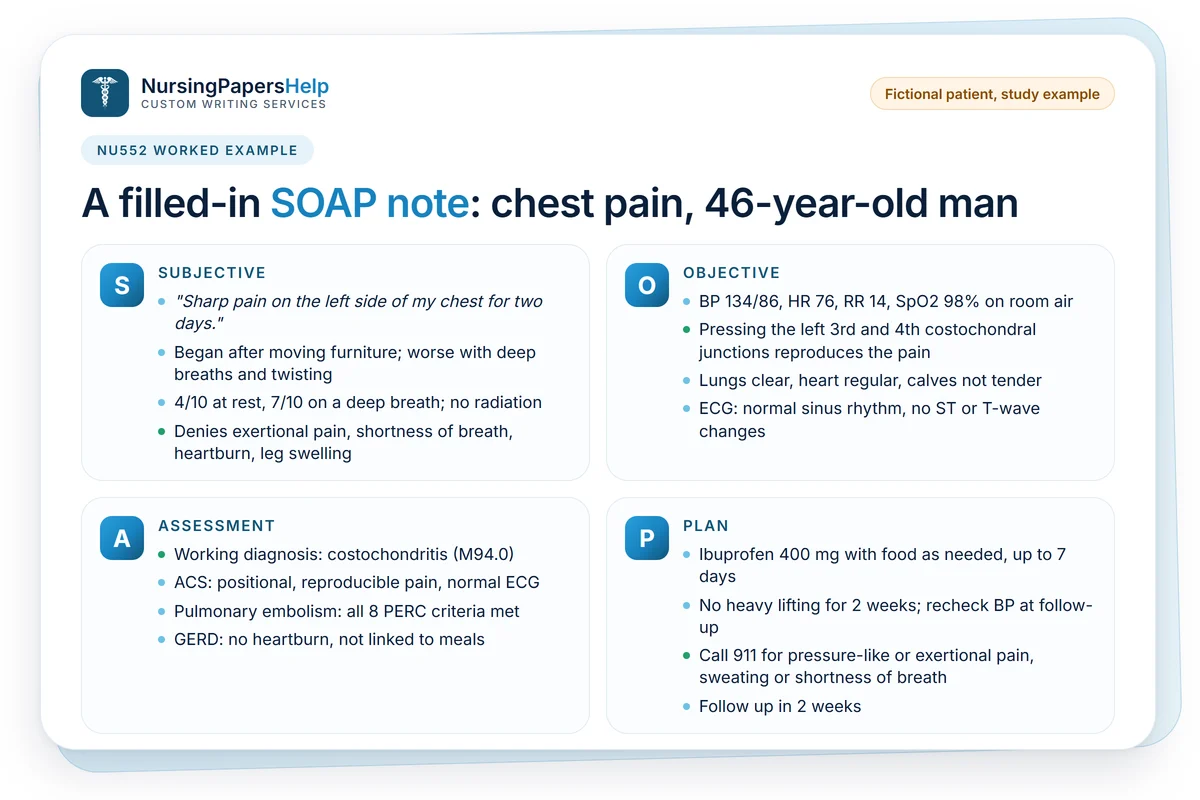
The worked NU552 SOAP note in this section uses an original, fictional patient: a 46-year-old man seen in primary care with two days of chest pain. The note shows pertinent negatives in the Subjective, a measured Objective, ranked differentials with findings for and against each, outpatient ICD-10-CM coding and a Plan tied to the 2021 AHA/ACC chest pain guideline.
The patient is invented for teaching. Copy the reasoning, not the wording, and write your own note from your own patient.
Subjective
Chief complaint: "Sharp pain on the left side of my chest for two days."
HPI: Mr. R., 46, reports left-sided chest pain that started two days ago, the morning after he helped a friend move furniture. The OLDCARTS elements:
- Location: left front of the chest, beside the breastbone. He points to it with one finger.
- Character: a constant dull ache with sharp jabs lasting a few seconds. "Like a bruise."
- Aggravating: deep breaths, twisting, lifting his left arm, lying on his left side.
- Relieving: one dose of ibuprofen 400 mg yesterday helped "a little."
- Radiation: none.
- Timing: present at rest and on exertion alike. Walking up stairs doesn't bring it on.
- Severity: 4/10 at rest, 7/10 on a deep breath.
History: hypertension for three years. Medications: lisinopril 10 mg daily. Allergies: no known drug allergies. Family: father had a myocardial infarction at 70; mother has type 2 diabetes. Social: never smoked, two beers a week, office manager, walks 30 minutes three times a week.
Review of systems:
- Constitutional: denies fever, chills, sweats, weight loss.
- Cardiovascular: denies exertional pain, palpitations, fainting, leg swelling.
- Respiratory: denies shortness of breath, cough, coughing up blood.
- Gastrointestinal: denies heartburn, regurgitation, trouble swallowing, nausea, pain after meals.
- Musculoskeletal: as in HPI; no other joint pain.
- Hematologic: no previous clots; no surgery, hospital stay, long trip or immobilization in the past month.
Objective
- Vitals: BP 134/86, HR 76 and regular, RR 14, temperature 36.8 °C, SpO2 98% on room air, BMI 29.
- General: well-appearing, in no distress, speaks in full sentences.
- Chest wall: point tenderness at the left 3rd and 4th costochondral junctions. Pressing there reproduces his pain exactly. No swelling, redness or crepitus.
- Lungs: clear on both sides, even chest expansion, no friction rub.
- Cardiovascular: regular rate and rhythm, normal S1 and S2, no murmur, rub or gallop. Radial pulses equal on both sides.
- Abdomen: soft, no tenderness, including the epigastrium.
- Legs: calves not tender, no edema, no swelling on one side.
- 12-lead ECG (in clinic): normal sinus rhythm at 74, no ST-segment or T-wave changes.
Assessment
Working diagnosis: costochondritis (ICD-10-CM M94.0)
Costochondritis is inflammation of the cartilage that joins the ribs to the breastbone. For: the pain began after heavy lifting, palpation at the costochondral junctions reproduces it exactly, it worsens with movement and deep breaths, and an NSAID gave partial relief. Against: nothing significant. Reproducible chest wall tenderness makes a cardiac cause less likely but doesn't remove it, so each must-not-miss diagnosis is addressed in turn.
Differential 1: acute coronary syndrome (must not miss)
Acute coronary syndrome (ACS) is the group of conditions caused by a sudden drop in blood flow to the heart, including myocardial infarction. For: male, 46, hypertension, BMI 29. Against: the pain is positional and reproducible, isn't brought on by exertion, and comes with no radiation, sweating, shortness of breath or nausea; the ECG is normal. What settles it: a single normal ECG doesn't exclude ACS on its own, so the Plan gives clear emergency precautions.
Differential 2: pulmonary embolism (must not miss)
A pulmonary embolism (PE) is a blood clot blocking an artery in the lungs. The Pulmonary Embolism Rule-out Criteria (PERC) are eight findings that, when all are met in a patient with low clinical suspicion, mean no further testing such as a D-dimer blood test is needed (Kline et al., 2004). For: the pain worsens on deep breaths. Against: no shortness of breath or coughing up blood, HR 76, SpO2 98%, no leg swelling, no recent surgery, travel or immobilization, no previous clots, no estrogen use. What settles it: he meets all eight PERC criteria.
Differential 3: gastroesophageal reflux disease (ICD-10-CM K21.9)
Gastroesophageal reflux disease (GERD) is the backflow of stomach acid into the esophagus. For: esophageal pain can mimic cardiac and chest wall pain. Against: no heartburn, regurgitation or trouble swallowing, no link to meals, and palpation reproduces the pain.
Aortic dissection and pneumothorax were also considered. Equal radial pulses, no tearing pain, normal breath sounds and normal oxygen saturation make both unlikely.
Plan
- Diagnostics: 12-lead ECG done today, normal. No further cardiac testing today, given non-exertional, reproducible pain with no associated symptoms and a normal ECG. Some instructors expect a documented risk score, such as HEART, or a troponin even here, so follow your rubric.
- Treatment: ibuprofen 400 mg by mouth every 6 to 8 hours with food as needed, for up to 7 days. Heat or ice to the area. No heavy lifting for two weeks.
- Blood pressure: NSAIDs can raise blood pressure and blunt the effect of ACE inhibitors such as lisinopril, so keep the course short and recheck BP at follow-up.
- Education: costochondritis usually settles on its own, though it can take several weeks or longer. Call 911 if the pain becomes pressure-like, comes on with exertion, spreads to the arm, jaw or back, or comes with shortness of breath, sweating, nausea or fainting.
- Follow-up: in two weeks, sooner if the pain changes or worsens.
Coding note: M94.0 is listed first because the note documents costochondritis as the diagnosis. If the note had said "probable costochondritis," the code would be the symptom instead: R07.89, other chest pain. ACS, pulmonary embolism and GERD aren't coded because they were considered and set aside. Hypertension (I10) is coded because it affects the treatment choice.
Why does this SOAP note score well?
The chest pain SOAP note scores well for five reasons:
- Every differential has findings for and against, taken from this patient's Subjective and Objective sections.
- Each must-not-miss diagnosis is ruled out by name. None is skipped because costochondritis looked obvious.
- Each pertinent negative in the review of systems maps to a differential: no shortness of breath or leg swelling for pulmonary embolism, no heartburn for GERD.
- Every Plan item has a reason, and the patient leaves knowing exactly when to call 911.
- Only the diagnosis that was made gets a code.
The NursingPapersHelp NU552 SOAP note sample on acute bacterial rhinosinusitis applies the same structure to a different body system.
Want a second pair of eyes on your own NU552 SOAP note? Send NursingPapersHelp your draft and the rubric. A nursing-trained writer marks it up line by line, from the pertinent negatives to the Plan citations, and explains each change so you can make it yourself. You see the exact price before you pay, by PayPal or card. Get feedback on your NU552 note
Should a student SOAP note include ICD-10 codes?
Student SOAP notes need ICD-10-CM codes only when the rubric asks for them, and the codes should follow the outpatient rules clinicians use. Under the ICD-10-CM outpatient guidelines (CDC/NCHS, FY2027), a probable, suspected or "rule out" diagnosis isn't coded. Code to the highest certainty for that visit, which is often a symptom such as chest pain.
ICD-10-CM is the U.S. diagnosis code set, maintained by the CDC's National Center for Health Statistics (NCHS). The outpatient rule comes from Section IV.H of the ICD-10-CM Official Guidelines for Coding and Reporting. The FY2027 edition took effect on 1 October 2026, and a new edition takes effect every 1 October, so use the current year's codes.
If the rubric doesn't ask for codes, leave them out. A wrong code you weren't asked for can only cost you.
The table shows what to code in five common outpatient situations.
| Situation at the visit | What to code | Example |
|---|---|---|
| Diagnosis made and documented | The diagnosis | Costochondritis, M94.0 |
| Diagnosis probable, suspected or "rule out" | The symptom or sign | Other chest pain, R07.89 |
| Symptom that's a routine part of the confirmed diagnosis | Don't code the symptom separately | Chest wall pain with costochondritis |
| Long-term condition that affects today's care | Code it as well | Hypertension, I10 |
| Diagnosis considered and ruled out | Nothing | Pulmonary embolism |
Inpatient coding works the other way. Under the inpatient rules, an uncertain diagnosis documented at discharge is coded as if it exists. Students who learned coding on a hospital unit and carry "probable" diagnoses into outpatient SOAP notes are applying the wrong rule.
What's the difference between a comprehensive and a focused SOAP note?
A comprehensive SOAP note documents a complete history and a head-to-toe exam, the kind done at a new-patient or annual visit. A focused SOAP note covers the chief complaint and the body systems related to it, plus enough history to rule out serious causes. Graders mark a focused note down for missing related systems, not for skipping unrelated ones.
The table compares the two note types point by point.
| Comprehensive note | Focused note | |
|---|---|---|
| When it's used | New patient, annual exam, admission | A specific complaint, follow-up |
| History | Full: medical, surgical, family, social, preventive | The HPI, plus history that bears on the complaint |
| Review of systems | Every system | The systems related to the complaint |
| Physical exam | Head to toe | Related systems, plus vitals and general appearance |
| Assessment | Several active problems and health maintenance | One problem with ranked differentials |
| Length | Long | Short, but complete for the complaint |
"Related systems" means every system that holds a possible cause of the complaint. In the chest pain SOAP note in this guide, the exam covers the heart, lungs, abdomen, chest wall and legs, because each holds a differential.
Skip the legs and you can't rule out pulmonary embolism.
How is the Shadow Health advanced health assessment set up?
Shadow Health's Advanced Health Assessment Digital Clinical Experience (DCE) is a simulation in which students interview and examine virtual patients. Tina Jones, 28, appears in a health history, single-system exams and a comprehensive assessment. Focused exams cover cough, chest pain and abdominal pain in three other patients, according to Shadow Health's 2018 learning objectives.
The table lists each Shadow Health module, its patient and what the student does, as set out in the 2018 learning objectives.
| Module | Patient | What you do |
|---|---|---|
| Health history | Tina Jones, 28, setting up primary care with a painful foot wound | Comprehensive health history |
| Single systems | Tina Jones, a different chief complaint in each module | Focused history and system exam |
| Comprehensive assessment | Tina Jones, six months after a hospital stay | Comprehensive history and head-to-toe exam |
| Focused exam: cough | Danny Rivera, 8 | Focused history and exam, SOAP note |
| Focused exam: chest pain | Brian Foster, 58 | Focused history and exam, SOAP note |
| Focused exam: abdominal pain | Esther Park, 78 | Focused history and exam, SOAP note |
Each Shadow Health module also has risk assessment questions, moments for patient education and empathy, and self-reflection questions. The health history module adds an information processing activity: you identify the diagnoses, prioritize them and plan for each. These details come from the 2018 objectives, so check the current version, and whether your NU552 section uses Shadow Health at all.
This guide doesn't give simulation answers or transcripts. For support with the simulation itself, see NursingPapersHelp's Tina Jones Shadow Health help.
Where do students lose points on NU552 assignments?
Six problems commonly cost points on SOAP notes in advanced health assessment courses like NU552: a differential without findings for and against, a dangerous diagnosis left off, exam findings written into the Subjective, a review of systems that repeats the HPI, a Plan with no guideline or citation, and APA 7 errors in the reference list.
Print the checklist and tick it with a pen the day before the note is due. At 11:50 p.m., with the submission page open, you'll skim it.
- The chief complaint is in the patient's own words.
- The HPI covers every OLDCARTS element.
- The review of systems adds new information and covers every related system.
- Each pertinent negative rules out a specific differential.
- The Objective section has a full set of vitals and nothing the patient said.
- Every differential has findings for and against.
- Every must-not-miss diagnosis is addressed, even if only to rule it out.
- ICD-10-CM codes follow the outpatient rules.
- Every Plan item has a reason and a citation recent enough for your rubric.
- In-text citations match the reference list, with DOIs and hanging indents.
- The patient can't be identified from the note.
- You know which time zone your deadlines use. Arizona doesn't observe daylight saving time, so in Phoenix or Tucson an 11:59 p.m. Central Time deadline is 10:59 p.m. on your clock in winter and 9:59 p.m. in summer.
Do SOAP notes need APA citations?
SOAP notes written for NU552 need APA citations wherever you argue: in the Assessment when you explain a ranking, and in the Plan when you justify a test or treatment. The current edition is the Publication Manual of the American Psychological Association (7th ed., APA, 2020). Put the reference list at the end of the note.
Cite the source itself. For the worked example in this guide, that means the 2021 AHA/ACC chest pain guideline in Circulation, not a hospital web page that summarises it.
Check three APA 7 rules in every SOAP note reference list. Write the DOI as a link (https://doi.org/...). Drop "Retrieved from." Use "et al." from the first in-text citation for any source with three or more authors.
How can you get NU552 help and stay within academic integrity?
NU552 help comes in three forms. A tutor can walk you through your patient's differentials, an editor can mark up your draft SOAP note against the rubric, and a writer can produce a note on your case in the format your course uses. Check your course's academic integrity policy for how you can use each.
The table shows three kinds of NU552 help and what you get from each.
| Kind of help | What you get | Best for |
|---|---|---|
| Tutoring | A walk-through of your patient's differentials and how to rank them | Building your own diagnostic reasoning |
| Feedback on your draft | Line-by-line comments against your rubric | Improving a note you've already written |
| A note written on your case | A SOAP note in the format your course uses | Seeing the standard expected, on your own patient |
Send the case details and findings, and we'll write the note in the format your course uses.
NursingPapersHelp's custom nursing SOAP notes are model notes on a case you choose, written from scratch by nursing-trained writers as study guides. Free revisions are included for 14 days under the NursingPapersHelp revision policy.
Your next step on NU552
Open your NU552 advanced health assessment rubric next to your draft. Score the draft against the NU552 checklist in this guide, one line at a time, and mark every line you can't tick. Then rewrite the Assessment first: every differential gets findings for and against, and the must-not-miss diagnoses come before the likely ones.
If a ranking or a code still looks shaky, compare it with the chest pain SOAP note in this guide. For a reader who'll mark it the way a grader would, send your draft and rubric to NursingPapersHelp for line-by-line feedback: you see the exact price before you pay, and the note stays yours.
Updated
Frequently asked questions
Can I use my clinic's EHR template instead of the SOAP format?
Only if your instructor allows it. An EHR (electronic health record) template auto-fills normal findings and hides your reasoning, and the reasoning is what NU552 grades. Write the note in SOAP order and type each finding yourself. The grader can then follow how the history and exam led you to your differentials.
What tense should a SOAP note be written in?
Use the past tense for the history and exam, because they describe what the patient reported and what you found at the visit. The Assessment and Plan usually use the present and future tense: what you think is happening now and what happens next. Keep one tense within each section, and check whether your instructor's template sets a different rule.
Can I use abbreviations in a student SOAP note?
Standard clinical abbreviations such as HPI, ROS, BP and PRN are fine. Avoid the abbreviations on The Joint Commission's "Do Not Use" list, such as U for unit and QD for daily, because they cause medication errors. If your instructor posts an approved list, follow it. Spell out anything a reader could misread.
Do I need a review of systems if I did a full physical exam?
Yes. The review of systems is subjective: what the patient tells you about each body system. The physical exam is objective: what you see, hear and measure. A finding can show up in one and not the other, and graders expect both, because the gap between the two often points to the diagnosis.
Can I reuse a SOAP note I wrote for another course?
Not without your instructor's permission. Reusing your own earlier work without permission is usually treated as self-plagiarism, and Purdue Global's academic integrity policy sets the exact rule. Write a new note from the new patient's data. Your template and the way you structure a differential can carry over. The text can't.
Is it okay to study from a model note on another patient?
Yes, as long as you use the model as a guide and write your own note. A model SOAP note on a different case shows the level of detail and reasoning your course expects. Compare its Assessment with yours and check the evidence it cites. Then write your note from your own patient's history and exam.
Should I use the patient's real name in a SOAP note assignment?
No. Remove the name and anything else that could identify the patient, such as exact dates, the clinic's name and record numbers. The HIPAA Privacy Rule's Safe Harbor method lists 18 identifiers to remove (45 CFR 164.514(b)(2)). Use the age, sex and a general setting instead, such as "a 46-year-old man seen in primary care."
Which Purdue Global courses build on NU552?
NU552 is one of the "three Ps", with NU551 pathophysiology and NU553 pharmacology, and the APRN Consensus Model (2008) requires separate graduate courses in all three. The SOAP notes and differentials practised in NU552 carry into the FNP clinical courses, such as NU568 Primary Care Across the Lifespan.
Popular services
- Reflective Journal Nursing
- Nursing Research Paper
- Nursing Case Study
- Healthcare Essay
- Health Essay Writing
- Medical Research Paper
- Nursing Assignment
- Nursing Dissertation
- Evidence Based Practice Writing
- PICO Question
- Medical Paper Writing
- Nursing Capstone
- Nursing Coursework
- DNP Nursing
- Nursing Term Paper
- i-Human Case Study Help
- Tina Jones Shadow Health
- MSN Writing Service
- Nursing Essay
- Nursing Report Writing
- Medical Writing Service
- BSN Nursing
- Nursing Thesis Writing
- PICO Project Writing
- Nursing Homework
- Nursing Reflection Paper
- Nursing Infographic
- Nursing Concept Map
- Presentation & PowerPoint
- Nursing Health Assessment Paper
- Custom Nursing SOAP Notes
Ready when your deadline is.
Get your exact price in seconds. No account, no card details on our site.
