Popular service
Nursing reflection paper help
Nursing writing service
Nursing Reflection Paper Help
Your experience analyzed with Gibbs, Driscoll or Johns, with a clear action plan.
- BSN, MSN & DNP levels
- Written from scratch
- Free revisions
- Written for your orderFrom your instructions and rubric
- Nursing-trained writersWriters with nursing degrees
- Your style and templateAPA 7, AMA or your school's format
- Your deadlineExact price before you pay
What's included?
- Your reflective model, stage by stage
- Anonymized details
- Analysis linked to evidence
- A specific action plan
What is a nursing reflection paper, and how is it different from a journal?
A nursing reflection paper is a formal essay about one clinical experience or a whole course: an introduction with a clear focus, an analysis built on a reflective model, links to evidence, and a conclusion about how your practice will change. A reflective journal is a series of shorter entries, usually written week by week.
Instructors set reflection papers at the end of a placement, after a simulation, or as the final assignment of a leadership or professional practice course. They read them for three things: an honest account of what happened, analysis that goes beyond feelings, and learning that is specific enough to act on. If your course asks for weekly entries instead, see our reflective journal writing help, which follows the same models in a diary format.
| Reflection paper | Reflective journal | |
|---|---|---|
| Length | Usually 3 to 6 pages | 1 to 2 pages an entry |
| Structure | Introduction, body by model stage, conclusion | One entry per shift or week |
| Sources | Several, cited in APA 7 | Often one or two |
| Typical course | Leadership, capstone, end of placement | Clinical rotations |
What do you get with our nursing reflection paper help?
You get a complete reflection paper written from your own account of the experience: a focused introduction, every stage of the reflective model your course uses, analysis linked to current nursing evidence, specific goals for your practice, and an APA 7 reference list. Patient and staff details are anonymized, and the paper follows your rubric's headings and length.
Every paper includes:
- Your reflective model. Gibbs, Driscoll, Johns, Kolb or Rolfe, applied stage by stage, with headings if your rubric wants them.
- Your voice. First person where reflection calls for it, written from the details you send, so the experience is recognizably yours.
- Evidence. Guidelines, nursing research or theory that explain what happened and why your learning matters.
- An action plan. Two or three specific, realistic goals, with how you'll know you've met them.
- Formatting. A title page, headings and references in APA 7, or the style your instructor uses.
How do you structure a nursing reflection paper?
Structure a reflection paper around one reflective model. Open with a short introduction that names the experience and what the paper will explore, work through the model's stages in order, support the analysis with sources, and finish with a conclusion and an action plan. Each stage gets its own paragraph or heading, so the instructor can follow your thinking.
Using Gibbs' reflective cycle
Gibbs' cycle is the most common model in nursing programs, and it maps neatly onto a paper. The University of Edinburgh's Reflection Toolkit sets out its six stages: description, feelings, evaluation, analysis, conclusion and action plan. Read our guide to Gibbs' reflective cycle in nursing for what to write at each stage.
Using Driscoll's "What? So what? Now what?"
Driscoll's three questions suit shorter papers. "What?" describes the event, "So what?" explains its meaning and the evidence behind it, and "Now what?" sets out the change in your practice. The model keeps a paper tight when your word count is low.
Where the evidence goes
Most of your sources belong in the analysis. If you reflect on a medication near-miss, for example, a source on the second victim experience or on safety culture explains your reaction and the system factors behind it. The description stage usually needs no citations, because it's your own account.
How do you write about feelings and mistakes professionally?
Write about feelings honestly and briefly, then move to what they tell you. Instructors expect first person in reflection, and APA Style accepts it when you describe your own actions and thoughts. Describe mistakes factually, without blaming colleagues, and spend most of the words on what you learned and what you'll do differently next time.
A few habits keep a reflection paper professional:
- Anonymize everything. No patient names, initials, dates, room numbers or facility names, and nothing rare enough to identify someone.
- Separate fact from interpretation. "The patient's oxygen saturation fell to 88%" is a fact; "I panicked" is a feeling. Both belong, in their own stages.
- Own your part. Reflection is about your practice. Discuss other people's actions only as far as they shaped your learning.
- Be specific in the action plan. "I will improve my communication" is too vague. "I will use SBAR for every call to a provider during my next placement" can be checked.
What reflection paper topics do nursing students write about?
Nursing reflection papers usually focus on one moment that changed how you think about practice: a first patient death, a communication breakdown, an ethical conflict, a medication error or near-miss, caring for a patient from a different culture, or leading a team for the first time. Course reflections look back on growth across a whole semester or program.
Common prompts include:
- A clinical experience that challenged your values
- Your development against a framework such as Benner's novice to expert stages
- What you learned from a high-fidelity simulation and its debriefing
- Your growth as a leader during a capstone or preceptorship
- How a theory or course concept changed your care of a patient
Our sample reflective journal on moving from novice to expert shows how a reflection links personal experience to a nursing framework.

How do you use Gibbs' reflective cycle in a nursing reflection paper?
Gibbs' reflective cycle, from his 1988 book Learning by Doing, takes you through six stages: description, feelings, evaluation, analysis, conclusion and action plan. In a nursing reflection paper, give the description and feelings a short paragraph each and spend most of your words on analysis, where you link the event to evidence and theory.
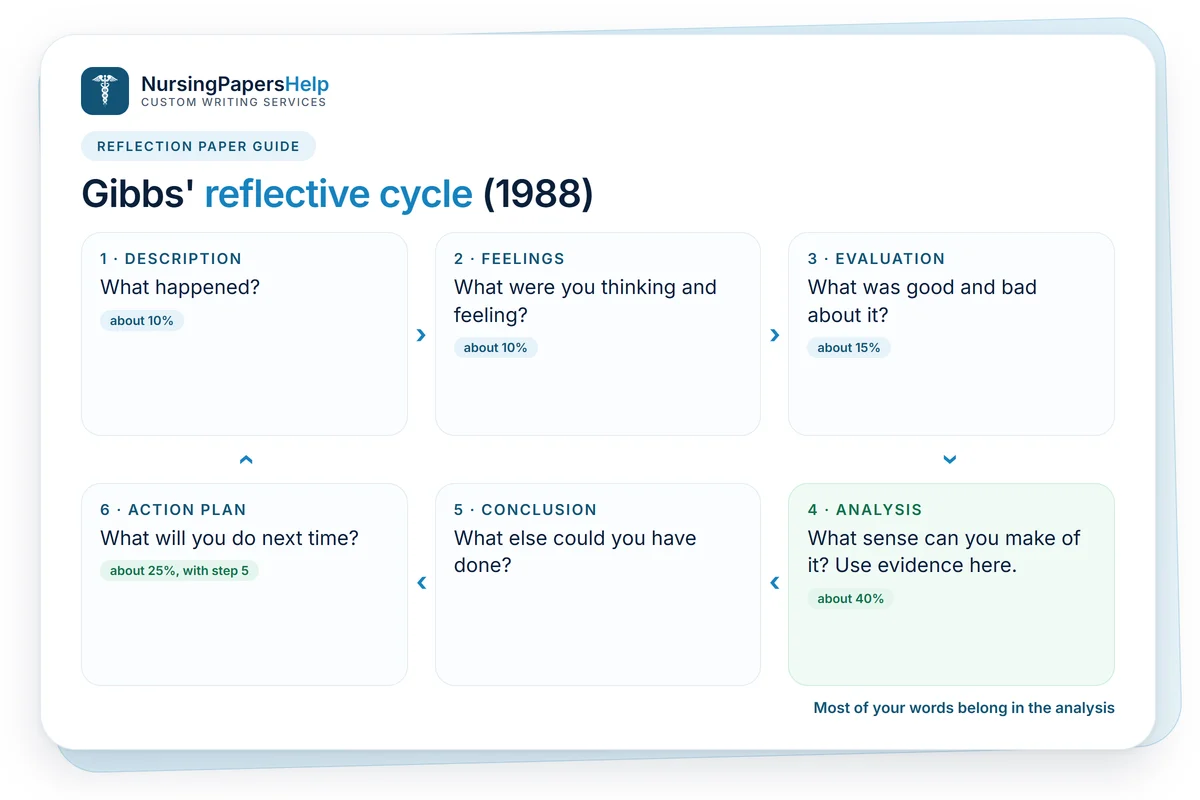
A common weighting for a 1,000-word paper:
- Description: about 100 words. What happened, where, and your role, with no identifying details.
- Feelings: about 100 words. What you thought and felt at the time.
- Evaluation: about 150 words. What went well and what didn't.
- Analysis: about 400 words. Why it happened, using at least two sources.
- Conclusion and action plan: about 250 words. What you learned and what you'll do differently, specifically.
More on the model is in our answer on Gibbs' reflective cycle in nursing.
Which reflective model fits your assignment: Gibbs, Johns, Driscoll or Kolb?
Use the model your instructor names; if none is named, match it to the event. Gibbs suits a single incident, Driscoll's "What? So what? Now what?" suits short reflections, Johns' model suits ethical or emotional situations, and Kolb's cycle suits learning a skill over time. Say which model you used and follow its stages as headings.
| Model | Stages | Best for |
|---|---|---|
| Gibbs (1988) | Description, feelings, evaluation, analysis, conclusion, action plan | One clinical incident in depth |
| Driscoll | What? So what? Now what? | Short weekly reflections and journals |
| Johns | Structured cue questions across ways of knowing | Ethical dilemmas, emotionally hard situations |
| Kolb (1984) | Concrete experience, reflective observation, abstract conceptualization, active experimentation | Building a skill across several shifts |
Whichever model you choose, the action plan should be specific enough to check: "I will use SBAR for every phone call to a provider during my next rotation," not "I will communicate better."
How do you use evidence in a nursing reflection paper?
Evidence belongs in the analysis stage, where you explain why the event happened and what it shows. Use a nursing theory, a clinical guideline, a professional standard or a study to make sense of your experience, and cite each in APA 7. Two or three well-chosen sources are usually enough for a 1,000-word reflection.
Match the source to the point you're making:
- A communication problem: a study on handoff errors, or the SBAR tool.
- An ethical dilemma: the ANA Code of Ethics for Nurses, with the provision that applies.
- A skill you struggled with: Benner's novice to expert model, to place where you are.
- Strong feelings after a hard shift: research on moral distress or compassion fatigue in nurses.
Keep your own voice. A reflection still uses "I," and the evidence should explain your experience rather than replace it. One sentence of source, one of what it means for what happened to you, is a good rhythm for the analysis.
Cite each source briefly and keep the focus on what you learned, not on the source.
One honest sentence about what you'd still find hard is worth more than a tidy ending.
What should you send for a reflection paper?
Send your own account of the experience: the setting, your role, what happened, what you thought and felt at the time, and what happened afterward, with every identifying detail removed. Add the assignment prompt, the rubric, the reflective model your course uses, the length and any sources your instructor requires. The more detail you give, the more personal the paper.
You can also say which parts of the experience matter most to you, and whether you want headings for each stage of the model. If you have a draft, upload it and ask for editing instead: we'll keep your words and strengthen the analysis and references.
How much does a nursing reflection paper cost?
Reflection papers are priced per double-spaced page, by your academic level and deadline, and the title page and references are free. Choose "Reflective journal" as the type of paper on the order form and you'll see the exact price before you pay. A 4-page BSN reflection with a week's deadline costs less than the same paper due tomorrow.
When the paper is delivered, you have free revisions for 14 days, or 30 days for orders over 20 pages, for changes that keep to your original instructions. For other writing in the same course, see our nursing essay writing help and our guide on how to write a nursing essay.
Sources
Updated
How much does it cost?
Your level and deadline set the price of each double-spaced page (275 words), and the title page and references are free.
What every order comes with
Free revisions for 14–30 days
Changes that keep to your instructions. Revision policy
Refunds by policy
Before work starts, or if we miss your deadline. Refund policy
Private and confidential
Private files and expiring download links. Privacy policy
Talk to us any time
From your order page, live chat or WhatsApp. Contact

How it works
Place your order
Type of paper, level, pages, deadline and files. See the price.
Pay securely
PayPal or a card on PayPal's page. Your deadline starts then.
Track and download
Follow progress, message support and download your paper.
Subjects we cover
34 nursing and health subjects. Not listed? Describe yours on the order form.
- Fundamentals of nursing
- Adult health / medical-surgical nursing
- Health assessment
- Pathophysiology
- Pharmacology
- Maternal-newborn and women's health
- Pediatric nursing
- Psychiatric-mental health nursing
- Community and public health nursing
- Gerontology
- Professional nursing and role transition
- Nursing ethics and law
- Evidence-based practice
- Nursing research and statistics
- Nursing theory
- Nursing leadership and management
- Quality improvement and patient safety
- Nursing informatics
- Health policy and advocacy
- Population health and epidemiology
- Healthcare economics and finance
- Nursing education
- Advanced pathophysiology
- Advanced pharmacology
- Advanced health assessment
- Family nurse practitioner (FNP) primary care
- PMHNP: psychiatric-mental health NP practice
- PMHNP: psychopharmacology
- PMHNP: psychotherapy and counseling
- PMHNP: psychiatric assessment and diagnosis
- PMHNP: care across the lifespan
- Capstone project
- DNP project
- Other (explain in the instructions)
Frequently asked questions
What is the difference between a reflection paper and a reflective journal?
A reflection paper is one formal essay with an introduction, analysis through a reflective model, sources and a conclusion, often three to six pages. A reflective journal is a series of short entries written after each shift or week. Both use the same models, but the paper goes deeper into one experience or a whole course.
Which reflective model should a nursing reflection paper use?
Use the model your instructor names. If you can choose, Gibbs' reflective cycle suits a single event and gives a paper six clear sections, Driscoll's three questions suit shorter papers, and Johns' model suits deeper reflection on values. Tell us your choice and the paper follows that model's stages in order.
Can I write a nursing reflection paper in the first person?
Yes. Reflection is about your own thoughts, feelings and actions, so first person is expected, and APA Style accepts it when you describe your own experience. Keep the analysis professional by linking what happened to evidence and theory, and keep patients and colleagues anonymous throughout the paper.
How long is a nursing reflection paper?
Most nursing reflection papers are three to six double-spaced pages, though an end-of-program reflection can be longer. Your rubric sets the length. One double-spaced page holds about 275 words, and the title page and references aren't counted, so order the page count of the body your instructor asks for.
What should I include in the action plan of a reflection paper?
Include two or three specific goals that come from what you learned, how you'll reach them and how you'll know you have. "I will use SBAR for every provider call during my next placement" is specific and checkable. Vague goals such as "I will communicate better" lose marks.
Can a reflection paper be about a mistake I made?
Yes, and instructors often value it. Describe the mistake factually, explain how you felt, analyze the personal and system factors behind it with evidence, and show what you'll do differently. Leave out anything that identifies the patient or staff, and focus on your own practice rather than blaming others.
What do I need to send for a reflection paper?
Send your own account of the experience with identifying details removed: the setting, your role, what happened, your thoughts and feelings, and the outcome. Add the prompt, rubric, reflective model, length and any required sources. The more detail you share, the more the paper sounds like you.
Do reflection papers need references?
Most do. Instructors expect the analysis to link your experience to nursing evidence, theory or guidelines, cited in APA 7 with a reference list. The description of what happened is your own account and needs no citations. Check your rubric for a minimum number of sources and their age.
Popular services
- Reflective Journal Nursing
- Nursing Research Paper
- Nursing Case Study
- Healthcare Essay
- Health Essay Writing
- Medical Research Paper
- Nursing Assignment
- Nursing Dissertation
- Evidence Based Practice Writing
- PICO Question
- Medical Paper Writing
- Nursing Capstone
- Nursing Coursework
- DNP Nursing
- Nursing Term Paper
- i-Human Case Study Help
- Tina Jones Shadow Health
- MSN Writing Service
- Nursing Essay
- Nursing Report Writing
- Medical Writing Service
- BSN Nursing
- Nursing Thesis Writing
- PICO Project Writing
- Nursing Homework
- Nursing Infographic
- Nursing Concept Map
- Presentation & PowerPoint
- Nursing Health Assessment Paper
- Custom Nursing SOAP Notes
Ready when your deadline is.
Get your exact price in seconds. No account, no card details on our site.
